
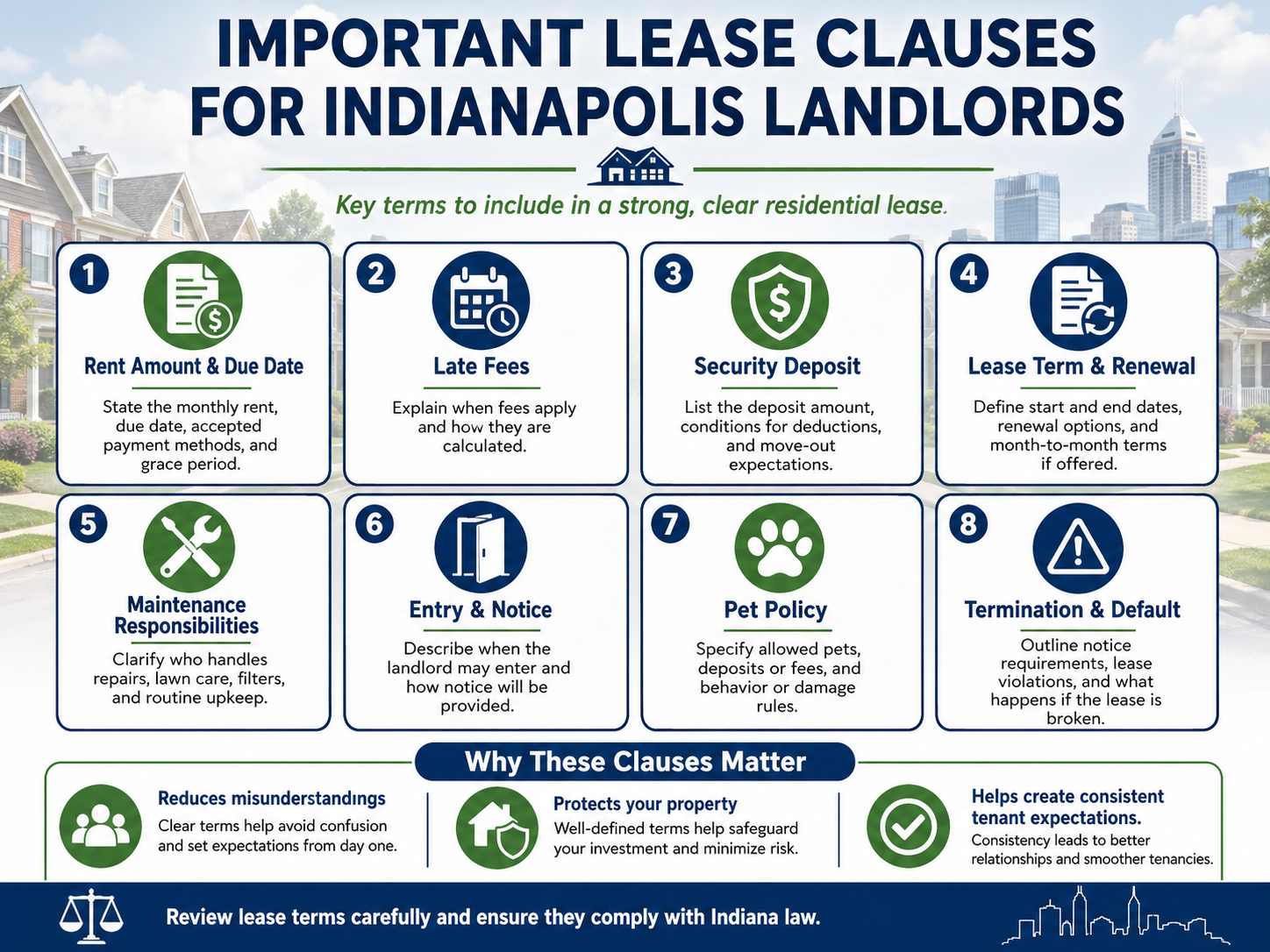
Lease Clauses Every Indianapolis Landlord Needs to Protect Their Rental Investment in 2026
Your lease agreement is not just a formality — it is the legal foundation of your entire landlord-tenant relationship. A well-drafted lease prevents disputes before they start, gives you enforceable remedies when problems arise, and keeps your Indianapolis rental operating in full compliance with Indiana law. A poorly drafted one does the opposite: it leaves you exposed to costly legal challenges, unenforceable provisions, and tenant disputes with no clear resolution path. For a complete term-by-term reference, the glossary of important lease clauses for Indianapolis landlords covers over 25 essential definitions in detail. This post takes a more strategic approach — walking through the five categories of lease provisions that Indianapolis landlords most commonly get wrong, and what each one needs to say to actually protect you.
Your Lease Agreement Is the Most Important Legal Document You Own as an Indianapolis Landlord

Many Indianapolis landlords underestimate what a lease actually does — or doesn’t do — until something goes wrong. A lease sets the rules of the tenancy, defines each party’s obligations, and establishes the legal procedures that apply when those obligations aren’t met. In Indiana, courts interpret lease agreements according to their plain language, which means vague or missing provisions don’t get resolved in the landlord’s favor — they get resolved against the drafter.
The consequences of a deficient lease are immediate and financial:
- Unenforceable late fees cost the average Indianapolis landlord $300–$600 per problem tenant per year in uncollected charges.
- Missing maintenance responsibility language creates disputes that regularly escalate to security deposit litigation or habitability claims.
- Improper entry notice provisions expose landlords to claims of harassment or breach of quiet enjoyment — even when the landlord’s actions were entirely reasonable.
- Defective eviction notice language can reset the entire eviction timeline, adding weeks of vacancy and thousands in lost rent to an already costly process.
- Absent or non-compliant security deposit clauses can cause landlords to forfeit their right to any deductions under Indiana Code 32-31-3.
The good news: every one of these risks is fully preventable with the right lease language from day one.
Foundational Clauses That Define the Tenancy: Term, Occupancy, and Entry Rights
The foundational clauses of a lease establish who lives in the property, for how long, under what terms, and when the landlord may access it. These provisions seem basic — and they are — but missing or vague language in any of them creates the conditions for the most common landlord-tenant disputes Indianapolis property managers encounter.
| Clause | What It Must Specify | Risk If Missing or Vague |
|---|---|---|
| Lease Term | Exact start and end dates; whether it auto-converts to month-to-month | Tenant may claim holdover rights; landlord loses ability to non-renew cleanly |
| Authorized Occupants | Full names of all approved residents; maximum occupancy limit | Unauthorized occupants gain de facto tenancy rights; eviction becomes legally complex |
| Landlord Entry Notice | Minimum notice period (24 hours per Indiana Code 32-31-5-6); permitted entry purposes | Entry without proper notice violates quiet enjoyment; exposes landlord to damages claims |
| Pet Policy | Whether pets are permitted; species and weight limits; pet deposit or pet rent amount | Tenant claims verbal permission; no enforceable remedy for unauthorized pets or damage |
| Subletting and Assignment | Explicit prohibition or written approval requirement for subletting | Tenant may legally sublet without consent if the lease is silent on the matter |
| Use of Property | Residential use only; prohibition on business operations, illegal activity | Difficult to enforce restrictions that are not expressly stated in the agreement |
Indiana courts have consistently held that ambiguous lease language is construed against the party who drafted it — in a landlord-drafted lease, that means ambiguity works against you. Every foundational clause should be specific, not general.
Financial Protection Clauses That Safeguard Your Rental Income Under Indiana Law
Financial clauses are where most Indianapolis lease agreements fall short. Landlords either use generic language that isn’t enforceable in Indiana, or omit provisions entirely — leaving them without legal recourse when tenants pay late, bounce checks, or leave the property owing money.
- Rent Amount and Due Date: State the exact monthly rent, the date it is due (typically the 1st), and the address or method of payment. Vague payment terms create collection ambiguity and complicate eviction filings.
- Grace Period and Late Fee: Indiana does not cap late fees, but they must be reasonable and clearly stated to be enforceable. Most Indianapolis landlords use a 3–5 day grace period followed by a flat fee of $50–$100 or 5–10% of monthly rent. Both the grace period length and fee amount must appear explicitly in the lease.
- Returned Check Fee: Include a specific NSF fee (typically $25–$50) and a provision allowing the landlord to require future payments by certified funds after a returned check. Without this clause, there is no contractual basis for charging the fee.
- Security Deposit Terms: Indiana Code 32-31-3 governs security deposits strictly. Your lease must state the deposit amount, the conditions under which deductions may be made, and the 45-day return deadline after tenancy ends. It must also inform tenants of their right to a move-in inspection — failure to do so limits your ability to deduct for pre-existing damage.
- Utilities Responsibility: Specify exactly which utilities the tenant is responsible for (gas, electric, water, trash) and which — if any — the landlord covers. Silence on this point routinely leads to disputes, especially in multi-unit properties with shared meters.
- Rent Increase Notice: For month-to-month tenancies, include language reserving the landlord’s right to adjust rent with proper written notice. Indiana requires at least 30 days’ notice; your lease should specify the notice method (written, delivered in person or by mail).
Maintenance, Property Condition, and Liability Clauses That Prevent the Most Costly Disputes
Maintenance disputes are the single most common source of security deposit litigation, habitability claims, and early lease termination in Indianapolis. The solution is a lease that clearly assigns responsibility for every category of maintenance before a problem arises — not after.
| Maintenance Category | Recommended Lease Language | Why It Matters |
|---|---|---|
| Routine Maintenance Requests | Tenant must submit requests in writing; landlord will respond within a specified timeframe (e.g., 48–72 hours for non-emergency) | Creates a written record; prevents “I never told you” disputes; supports habitability compliance |
| Emergency Repairs | Define what constitutes an emergency (flooding, no heat, gas leak); provide 24/7 emergency contact number | Indiana courts expect prompt response to habitability emergencies; documented process limits landlord liability |
| Tenant-Caused Damage | Tenant is responsible for repairs beyond normal wear and tear; define normal wear and tear vs. damage | Without this distinction in writing, security deposit deduction disputes become difficult to win in court |
| HVAC Filter Maintenance | Tenant must replace filters every 30–90 days; failure constitutes a lease violation | Neglected filters are a leading cause of HVAC system failures — a $3,000–$8,000 replacement cost |
| Alterations and Modifications | No alterations without prior written landlord consent; tenant responsible for restoration costs | Prevents unauthorized painting, fixture changes, or structural modifications without remedy |
| Renter’s Insurance Requirement | Tenant must maintain renter’s insurance with minimum liability coverage; provide proof within 14 days of move-in | Protects tenant’s personal property; reduces landlord liability exposure for tenant negligence claims |
At Discover Properties, LLC, our managed properties include a comprehensive maintenance protocol — documented repair requests, licensed vendor coordination, and move-in/move-out inspection reports — that creates an airtight record supporting every security deposit decision.
Lease Violation, Termination, and Eviction Clauses That Hold Up Under Indiana Law
The clauses that govern what happens when things go wrong are the ones most landlords never think about until they need them. By then, it’s too late to fix a lease that doesn’t give you enforceable remedies. Indiana has specific procedural requirements for lease enforcement and eviction — and your lease must align with those requirements precisely to be effective.
- Notice to Cure: Your lease should specify that certain violations (noise, unauthorized occupants, lease rule infractions) trigger a written notice giving the tenant a defined period — typically 30 days under Indiana Code 32-31-1-6 — to correct the violation before termination proceedings begin.
- Non-Payment of Rent Notice: Indiana requires a 10-day written notice to pay or vacate before filing for eviction on non-payment grounds. Your lease should reference this requirement and specify your preferred delivery method (hand delivery, certified mail) to ensure the notice is legally valid.
- Prohibition on Self-Help Eviction: Indiana law explicitly prohibits landlords from removing a tenant’s belongings, changing locks, or shutting off utilities as a means of eviction. Include a clause acknowledging this prohibition — it demonstrates awareness and protects you if a tenant ever makes a wrongful eviction claim.
- Abandonment: Define what constitutes property abandonment (e.g., 15+ consecutive days without contact, rent unpaid, and personal belongings removed). Indiana Code 32-31-4 governs abandoned property procedures — your lease should reflect this and specify how the landlord will handle personal property left behind.
- Early Termination: Specify whether early termination is permitted, under what conditions, and what fee or liability applies. A clear early termination clause reduces disputes and gives both parties a defined path if circumstances change.
- Attorney’s Fees and Court Costs: Include a prevailing party clause specifying that the tenant is responsible for reasonable attorney’s fees and court costs in the event of litigation arising from a lease violation. This deters frivolous disputes and provides a remedy for your enforcement costs.
Protect Your Indianapolis Rental with a Professionally Drafted Lease
A lease agreement is only as strong as the language it contains. Generic online templates routinely miss Indiana-specific requirements, leave financial protections unenforced, and fail to reflect the realities of the Indianapolis rental market. At Discover Properties, LLC, every property we manage is protected by a professionally drafted, Indiana-compliant lease — updated to reflect current law and tailored to the specific property and tenancy.
If you want the peace of mind that comes from knowing your lease is airtight, call our Indianapolis office at 317-254-8888 or contact Discover Properties online to learn how our full-service property management protects your investment from day one.
Frequently Asked Questions
What lease clauses are required by Indiana law?
Indiana law does not mandate a specific lease format, but Indiana Code 32-31 requires or implies several key provisions — including the landlord’s name and address for notice purposes, security deposit terms and return conditions, the tenant’s right to a move-in inspection, and habitability compliance. Leases must also conform to federal and Indiana Fair Housing requirements. Missing or non-compliant provisions can limit your legal remedies significantly.
How much can an Indianapolis landlord charge for a late fee?
Indiana does not cap late fees by statute, but courts expect them to be reasonable and proportionate. Most Indianapolis landlords charge a flat $50–$100 or 5–10% of monthly rent, applied after a grace period of three to five days. Both the fee amount and grace period must be explicitly stated in the lease to be legally enforceable — courts will not imply a late fee that isn’t written into the agreement.
Can an Indianapolis landlord enter a rental property without notice?
No. Indiana Code 32-31-5-6 requires landlords to provide reasonable advance notice before entering a rental unit — generally interpreted as at least 24 hours — except in genuine emergencies such as fire, flooding, or serious safety hazards. Entering without proper notice violates the tenant’s right to quiet enjoyment and can expose landlords to damages claims. Entry notice requirements should be clearly defined in every lease.
What happens if a tenant violates the lease in Indianapolis?
Indiana law requires landlords to follow a specific notice-and-cure process before initiating eviction. For non-payment of rent, a 10-day written notice to pay or vacate is required. For other lease violations, a 30-day notice to cure is standard. If the tenant does not comply, the landlord may file in Marion County Small Claims or Circuit Court. Self-help eviction — changing locks, removing belongings, cutting utilities — is illegal in Indiana regardless of the lease violation.
How long does a landlord have to return a security deposit in Indiana?
Under Indiana Code 32-31-3, landlords must return the security deposit or provide an itemized written statement of deductions within 45 days of the tenancy ending and the tenant vacating. Missing this deadline can cause landlords to forfeit the right to any deductions and owe the full deposit back to the tenant, along with potential court costs. Documenting all deductions with receipts and photos is essential.
Should Indianapolis landlords use a generic online lease template?
Generic online templates rarely include Indiana-specific disclosures, required security deposit language, or the practical protections Indianapolis landlords need. A lease that lacks proper entry notice provisions, maintenance responsibility clauses, or Indiana-compliant eviction language can leave landlords exposed — even if the document looks thorough. Discover Properties, LLC uses professionally drafted, Indiana-compliant leases for all managed properties to ensure full legal protection from move-in to move-out.